
BOOK REVIEW
Psychologist Cimbalo’s manifesto asserts that attempts to shoehorn people into generic categories are scientifically invalid and socially disastrous. The author argues that, because “all things in the universe are different,” any efforts to group them and discern uniform underlying properties are illegitimate. He applies this principle to everything from geometry—“In the real world, there are no perfect triangles where the three angles sum to 180 degrees”—to medicine, contending, for example, that it’s impossible to say whether a drug is uniformly safe and effective, as it depends on each patient’s unique circumstances. (He further calls for the repeal of legal restrictions on alcohol and recreational drugs.) Cimbalo goes on to critique various social institutions, including government, the military, religion, science, art, and business. These “earth gods,” he argues, gain power by imposing collective rules and false doctrines of “oneness and truth” on people to protect them from the “One True God”—his term for a reality that’s frighteningly changeable, multifarious, and chaotic. The result of this pervasive “bamboozlement,” Cimbalo contends, is a world where the powerful oppress the weak; people are fired and shunned for exercising free speech; dissidents are ostracized; marriages founder because spouses won’t allow for individual differences; and the U.S. government attacks groups for simply being different. Cimbalo’s analysis of human groupthink is far-reaching and draws on readings of such thinkers as Plato, Sigmund Freud, and Karl Popper to illuminate profound philosophical questions about how people understand the world and its commonalities. He conveys his vision in lucid prose with colorful, arresting imagery. (America, he says at one point, has “become a nation of always-hungry sharks patrolling to disable and consume the less powerful and our perceived enemies.”) Some stances feel underdeveloped—such as his condemnation of insurance for making policy-holders at large pay for individual mistakes—and his rejection of humans’ propensity for noticing similarities, discerning categories, and abstracting regularities seems like an attack on human cognition itself. Still, readers who chafe at grand narratives will find much to ponder here.
An often penetrating and energetic, if idiosyncratic, challenge to conventional wisdom.

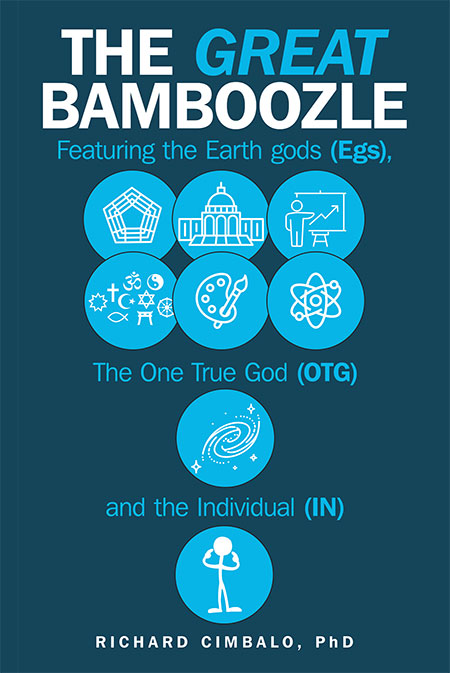
The Great Bamboozle
Richard Cimbalo, PhD
Publisher: Archway Publishing Pages: 144 Price: (paperback) $16.99 ISBN: 9781665778107Reviewed: June, 2026Author Website: Visit »
Psychology Professor Richard Cimbalo’s The Great Bamboozle is an ambitious socio-philosophical treatise offering a pragmatic epistemology that argues that state, military, religious, business, art and science institutions curate and interpret our experiences to cultivate and express power. While he leans frequently on the ideas of French philosopher Michael Foucault, Cimbalo’s ideology tends toward a characteristically American political libertarianism.
Cimbalo argues that because we are psychologically predisposed to see the whole, rather than underlying constituent parts, we are ill-equipped to process difference and individuality. Thus, he seems to argue, as noted above, that truth amounts to exercises in power. Attempting to illustrate how these concepts relate, he weaves his way through numerous recent historical events and political movements and explores the philosophical assumptions underpinning scientific understanding.
It’s a big task, and there are some pitfalls: first, because the connections between ideas often feel loose, and second because Cimbalo’s self-described conservative political views make a number of unnecessary appearances, such as a clunky attempt to cast Oklahoma City bomber Timothy McVeigh as a potentially justified freedom fighter reacting to state overreach symbolized by the Waco siege. When he comes around to describing his theory of power, however, he offers provocative ideas that have considerable implications for science and the pursuit of personal freedom — but certainly the text asks more questions than it answers.
This offering is best suited to readers interested in sociology or philosophy, particularly those with a postmodern bent. Whether readers feel rewarded for the effort is an open question, not because the subjects aren’t worth exploring but because Cimbalo’s connections are often tenuous, personal, or idiosyncratic to his own interests. For readers unafraid of such academic messiness, this book might offer a useful change in perspective to help make sense of the world and our place in it.
Also available in hardcover and ebook.

The Great Bamboozle: Featuring the Earth Gods (Egs), the One True God (OTG), and the
ndividual (IN)
Forwarding grand metaphysical arguments about the natures of being and knowledge, The Great Bamboozle is a piquing philosophical treatise.
Richard Cimbalo’s polemical text The Great Bamboozle investigates human consciousness.
Arguing that powerful institutional structures, or earth gods, impose simplified categorical wholes, singularity, and illusory order upon the infinite diversity of reality, this text asserts that such cultural creations mask the ultimate reality of “one true god.” Divine power is defined herein as the chaotic energy that drives all movement and change across the universe. Examinations of behavioral learning theories and the cognitive mechanics of categorization are used to support these arguments.
Esoteric elements, including a detailed taxonomy of the six earth gods (state, military, religion, business, science, and arts) and an encompassing model of power that represents a unique heuristic for understanding human cognition and social institutions, render the text quite dense, limiting its general accessibility. Its series of interconnected philosophical and social inquiries, which are used to reveal connections across disciplines including philosophy, behavioral psychology, epistemology, and political theory, are also abstruse. Further, the book’s structure is quite fragmentary; its core concepts and ideas, including that “no two things are alike,” reappear across the book, revisited from numerous perspectives, resulting in discord and drag.
The rhetorical prose leans into vivid metaphors to make its points; personal anecdotes are also employed to ground its loftier concepts, as with childhood memories that are used to illustrate the assertion that no two things in the universe are the same:
My mom would tell a story about me at about twelve-months of age engaged in a conversation with my next-door neighbor, Mr. Mesner. When his brother joined us and was introduced to me as Mr. Mesner, I immediately shook my head and said, “No. There can’t be two Mr. Mesners.” Even back then, this idea, that no two things can be the same, was percolating in my developing brain.
Not all such illustrations stand to compel general audiences, though.
The book’s oversized paragraphs and limited white space also lead to visual crowding, further undermining the book’s ambitious goal of exposing the manipulative nature of social categorizations to the world. Indeed, while the book’s arguments are provocative and are forwarded in an earnest manner, challenging the legitimacy of everyday institutional categories with aplomb and working to expose the tensions and contradictions embedded within accepted systems of thought, their ultimate persuasiveness is limited.
A provocative philosophical treatise, The Great Bamboozle makes intriguing arguments about the fundamental ways in which human beings perceive reality.